28 Progressive Revenue Options at a Glance
This new tool describes 28 ways the Commonwealth could generate substantial new revenue in a manner that would fall least heavily on people with the least ability to pay. Each option presented below is economically progressive (see breakout box, below). Therefore, each proposal requires households with high incomes to contribute more as a share of their household income than households with low or moderate incomes would. Massachusetts could enact one or many of these policies and thereby start raising additional revenue without delay while also reducing inequality.
In the tool below, click on a particular category or revenue option to learn more.
Why progressive revenue?
People in Massachusetts seek to live in communities that provide a high quality of life for their family and neighbors. Our state values good schools, libraries and parks, smooth roads and reliable public transit, local safety and fire protection, as well as public supports that help families struggling through tough times. A community’s day-to-day wellbeing and its long-term prosperity are built on investing in these fundamentals. State and local taxes are the primary way the Commonwealth generates the resources to pay for these investments. How to collect the needed revenue in a way that places the largest obligation on those with the greatest ability to pay is a question that every community and every state should consider and answer.
Large tax cuts enacted in Massachusetts during the last several decades have significantly reduced the Commonwealth’s ability to invest in our communities. This includes the 2023 tax cut package which reduced state collections by over $1 billion a year. One notable exception in this long trend of regressive tax cuts is the approval by Massachusetts voters in 2022 of the Fair Share surtax on very high incomes. This highly progressive surtax raised about $3.4 billion last fiscal year (FY 2026), all of which is dedicated to supporting public education and transportation needs throughout the Commonwealth.
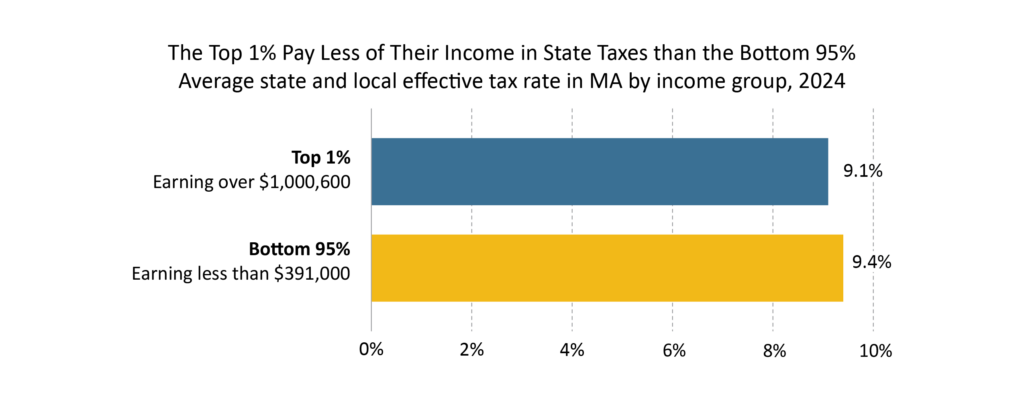
Even accounting for the Fair Share surtax, Massachusetts’ state and local tax system is still not progressive. On average, households with low and moderate incomes pay a larger share of their income in state and local taxes than the households with the highest incomes do. One reason is because taxes on consumption, such as sales taxes, are regressive and borne more heavily by households with low and moderate incomes. These households’ incomes are increasingly being stretched to the limit to afford basic necessities. By contrast, the households with the highest incomes can place most of their income in investments, which receive many tax advantages and may never be subject to tax at all.
Tax Fairness
“Ability to pay” is a common measure used to understand whether a tax is fair. If households with low and moderate incomes – i.e., those households with less ability to pay – end up paying a greater share of their income in tax than high-income households do, then the tax is said to be “regressive”. If the reverse is true – if households with high incomes pay a larger share of their income in tax than households with low and moderate incomes do – then the tax is said to be “progressive.”
A state or local tax that is regressive is less fair than a tax that is progressive. Households with less ability to pay should not be asked to contribute a greater share of their income in taxes than households with high incomes do. Instead, households with high incomes should contribute a greater share than households with low and moderate incomes do.
 Income inequality in the United States is extreme and has grown much worse over the last several decades. Massachusetts has among the highest levels of income inequality of all 50 states. And the problem is getting worse. Massachusetts has trended toward greater inequality since at least the Great Recession (roughly 2008-2009). Although not regularly measured at the state level, a similar story holds true for nationwide wealth inequality.
In the United States, disparity in wealth is even more extreme than income inequality. Nationwide data shows that wealth inequality has grown over the last several decades, and the 2025 federal government’s One Big Beautiful Bill (OB3) will exacerbate these disparities as it is implemented fully over the coming several years. A Federal Reserve Bank of Boston (FRBB) survey published in 2026 also found steep wealth inequality in Massachusetts. The average net family wealth in Massachusetts is just over one million dollars; although, this high average largely reflects a high concentration of wealth among the richest families. For a typical (median) family in Massachusetts, the figure is $374,000.
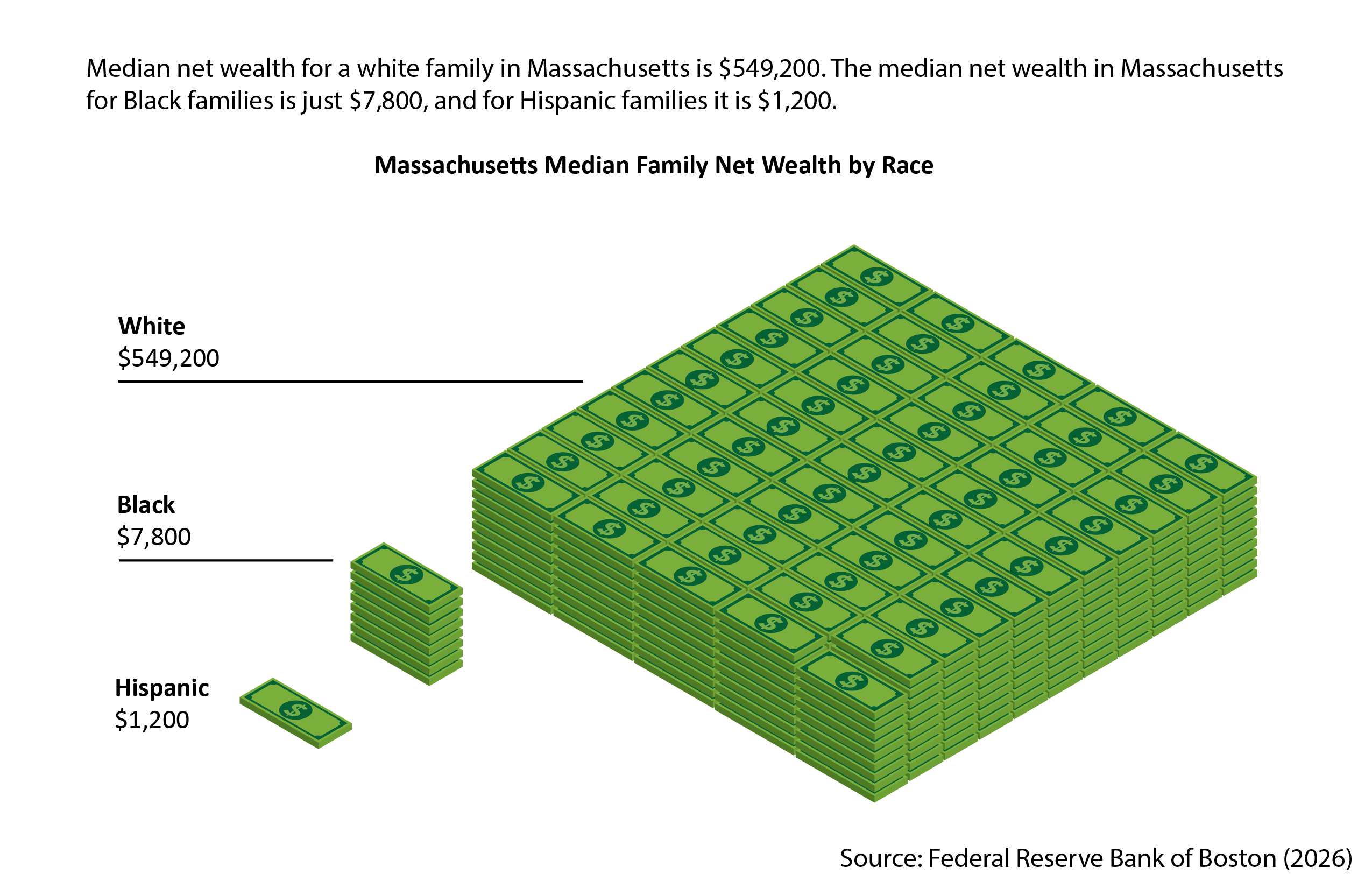
Disparities in wealth by race are still more extreme. The same FRBB survey found that the median net wealth in Massachusetts for Black families is just $7,800, and for Hispanic families it is even less: $1,200.[1] One-in-nine white families have zero or negative net wealth, compared to over 3-in-10 Black families and 4-in-10 Hispanic families.[2]
The way in which public revenue is generated – i.e., the kinds of taxes and fees used by federal, state, and local governments – can make inequalities in income and wealth either more or less extreme. Regressive taxes make existing inequalities worse, fracturing shared civic experiences between communities, and preventing large sectors of the population from accessing the resources that would allow them to thrive. Black and Latino communities in particular tend to be impacted disproportionately by regressive taxes. Due to a long history of systemic racism and barriers to opportunity, Black and Latino households are over-represented in groups with lower incomes and under-represented in groups with higher incomes.
Choosing progressive ways to collect revenue, by contrast, helps reduce these extreme disparities over time, raising revenue primarily from those most able to pay. Progressive taxes improve equality across society. This will enable greater economic opportunity for households with low and moderate incomes. Greater equity and more opportunity helps everyone participate more fully in society and benefit more meaningfully from our economy. With greater economic security, people are better able to engage in civic and political life, a cornerstone of a functioning democracy.
Compounding the inequities in state and local tax systems, Congress enacted federal tax cuts at the end of 2017 (the Tax Cuts and Jobs Act, or TCJA) and then, in 2025, expanded these tax cuts through the One Big Beautiful Bill Act (OB3). These federal tax cuts are skewed extremely heavily toward the households with the highest incomes. Massachusetts households in the top one percent by income (i.e., those with annual incomes above $1.1 million), will receive an average annual federal tax cut of $98,600.[3] Meanwhile, those in the lowest 20 percent by annual income will see an annual average tax increase of $10 per household. Nationwide, the federal revenue loss from the 2025 tax cuts provided to the richest 1 percent of Americans will cost $1 trillion over the coming decade.
The need for new sources of state revenue has become still more pressing because the federal administration and Congress – in order to pay for some of the enormous cost of the large and regressive federal tax cuts – made deep cuts to federal programs such as:
- The Supplemental Nutritional Assistance Program (SNAP),
- Medicaid (MassHealth),
- Federal student financial aid,
- The Women, Infant, and Children (WIC) food access program,
- The state health insurance marketplace, and
- Other federally-supported safety net programs.
These federal cuts along with other federal policy choices will directly harm hundreds of thousands of people in Massachusetts. The cuts will result in further, indirect harms due to hospital closures, canceled grants, and more. Federal changes threaten to shift large costs onto the states, potentially creating very large revenue holes in the Massachusetts state budget. Securing the additional resources to bridge these gaps in the near and the long term will require our state lawmakers to identify and adopt new, state-level sources of revenue. It is important that these new revenues are progressive, meaning that the revenue should come primarily from households with higher incomes. Otherwise, regressive revenue policies will deepen existing inequalities in economic opportunity, worsen affordability problems for households with low and moderate incomes, and further erode our democracy.
Four Kinds of Progressive Revenue Options
In this report, the policies for generating progressive revenue are organized into four categories: taxing income, taxing wealth, taxing corporations, and ending tax breaks for luxuries. Few consumption-related taxes or fees appear in this list because consumption taxes – such as sales taxes and vehicle registration fees – generally are regressive rather than progressive.[4]
- Personal Income – Income is money or resources that flow to an individual over time. For most working people, their most important form of income is their wages or a salary. Wealthier people tend to receive more of their income from their investments, in the form of dividends paid out to stockholders, the sale of stocks and other financial assets, rent collected on leased property, and profits from businesses they own. Since income in the United States is distributed very unequally, taxing income is an effective way to reduce inequality, especially when personal income taxes are targeted at households with higher incomes.
- Wealth – Wealth is an accumulated stockpile of resources, such as savings accounts, real estate, or corporate stocks and bonds. Since the 1970s, our nation’s wealth has become increasingly concentrated in the hands of a small percentage of the population. Ownership of financial assets, such as stocks, and business ownership is especially concentrated in a few hands. As mentioned earlier, studies find that large pools of wealth held by high-wealth individuals have often been subject to little or no tax.
- Corporations – Corporate ownership is highly concentrated in the most affluent households, which benefit most from the profits and rising share prices of those corporations. Taxes on corporations that claim a portion of those profits fall primarily on corporate shareholders, thus making the impact of corporate taxes progressive.
Of course, not all businesses are the same. The large majority of American businesses are small operations. Most are sole proprietorships, and most of the rest employ just a few people. However, the economy is dominated by a relatively small number of very large corporations that have operations throughout the United States and in many countries around the world. Businesses depend on public investments, such as good roads, quality schools, healthy and skilled workers, functioning water systems, responsive emergency services, and other public services and infrastructure. It is reasonable to require the largest corporations with the greatest resources and disproportionately owned by the wealthiest households to help support these public systems on which their profits depend. Ending special tax breaks that actively favor larger corporations over small businesses can be a particularly good way to raise progressive revenue.
- Luxuries – In general, it does not make sense to subsidize the goods or services that households with higher incomes are more likely to use. More affluent households are less likely to need the tax break. Moreover, if the goal is to encourage purchases of a certain type of good or service, tax incentives will deliver less bang for the buck for households with higher incomes. This is because their consumption behavior tends to be less responsive to reductions in costs. Tax subsidies that incentivize consumption of particular goods or services make even less sense if that consumption imposes other costs on society, such as by increasing pollution. Eliminating such subsidies is a beneficial way that states can generate additional progressive revenue.
This report describes 28 ways the Commonwealth could generate substantial new revenue in a manner that would fall least heavily on people with the least ability to pay. Each option presented below is economically progressive (see breakout box, below table). Therefore, each proposal requires high-income households to contribute more as a share of their household income than households with low or moderate incomes would. Massachusetts could enact one or many of these policies and thereby start raising additional revenue without delay while also reducing inequality.
Personal Income
1. Increase the Personal State Income Tax Rate
The largest source of tax revenue for the Commonwealth is the personal income tax. In Fiscal Year (FY) 2026, the personal income tax raised $28.8 billion, or 63 percent of total state tax revenue in Massachusetts.[5] The state constitution currently requires the personal income tax to have a single, uniform rate, applied to all levels of income (unlike the federal income tax system which applies higher tax rates to several brackets of higher income).[6] In 2022, Massachusetts voters approved the Fair Share Amendment. This changed the state constitution by applying a 4 percent surtax to personal income exceeding an annually inflation-adjusted $1 million.[7] Nonetheless, even apart from the surtax, the flat-rate personal income tax paired with exemptions and credits provided to households with low and moderate incomes is a progressive source of revenue. Households with higher incomes tend to pay a larger share of their income toward this tax than households with low and moderate incomes do because of various exemptions and credits that disproportionately benefit households with low and moderate incomes. (See a discussion of exemptions and credits under Option #2.)
The most straightforward way to increase revenue from the personal income tax is to raise the state’s single, uniform rate. Restoring the current 5.0 percent tax rate to 5.95 percent – the rate in effect in the late 1990s – would have generated almost $5.5 billion in additional revenue in FY 2026. While the large majority of this additional revenue would come from households with higher incomes, most households with low and moderate incomes would also pay somewhat more in personal income taxes under such a scenario.
2. Raise both the personal state income tax rate and progressive exemptions/credits
As noted above, apart from the Fair Share surtax, the Massachusetts personal income tax applies a single rate to almost all personal income, but is still progressive because the state tax code contains a number of important exemptions and credits for workers with low and moderate incomes. Together, these exemptions and credits reduce the share of personal income paid in taxes by households with low and moderate incomes.[8] By combining an increase in some or all of these exemptions and credits with an increase in the overall personal income tax rate, substantial new revenue can be generated for the Commonwealth. This would simultaneously insulate many filers with low and moderate incomes from significant tax increases.[9] Some households with low and moderate incomes would even see a net reduction in their state income tax.
Certain tax exemptions and tax credits are particularly important to the progressivity of the Massachusetts income tax. The state’s automatic personal exemption reduces the amount of income subject to tax by $4,400 for single filers and $8,800 for married couples. Exempting a fixed dollar amount of income from tax provides a proportionately larger tax reduction for taxpayers with low and moderate incomes than for those with higher incomes. This is because a smaller share of the income for taxpayers with low and moderate incomes remains subject to tax.
Tax Credits, Exemptions, and Deductions
Tax credits are a credit against a tax bill. Each dollar of credit reduces the tax bill by a dollar. “Refundable” tax credits also provide a refund payment to the tax filer if the credit makes the tax bill less than zero.
Tax deductions and exemptions subtract from the amount of income subject to tax or remove some type of income from taxation. The value of a deduction or exemption depends on the tax rate that applies to the tax filer’s income. If the amount of income subject to tax is reduced by $100 and the income would be taxed at 5 percent, then the value of the credit or exemption for the filer is $5.
Income taxes are made more progressive in Massachusetts by a number of refundable tax credits available to individuals and families. Unlike exemptions, which merely shield some income from being subject to tax, a refundable credit is subtracted from the final tax bill. A refundable credit benefits tax filers who might already receive a refund by providing these filers with a larger refund. For example, the state Earned Income Tax Credit (EITC) is a refundable tax credit benefiting households with low incomes, with more credit provided for larger families. The amount of the EITC depends on a filer’s earned income and phases out as income rises. By increasing the credit and/or expanding eligibility to include children of a greater age range, the credit’s progressivity would be increased. Another example is the state’s Child and Dependent Tax Credit which provides a $440 refundable credit for each child or each dependent adult over 65 years of age or with disabilities. The credit represents a relatively larger benefit to households with lower incomes and to households with dependents, which are likely to be in greater need. Increasing the value of the tax credit would increase tax progressivity, as would increasing the age for eligible children, and adjusting the credit for inflation in the future.
There is a trade-off, however, between making a package of tax changes more progressive by increasing these exemptions and credits, and the amount of new revenue that would be generated. For example, increasing the overall income tax rate to 5.95 percent with significant increases in exemptions and credits might generate $4 billion in additional revenue rather than the full $5.5 billion noted above. This approach would be more progressive but would generate less revenue than simply increasing the overall rate to 5.95 percent.
3. Raise the tax rate on capital gains, dividends, and interest
While Massachusetts’ state constitution requires that tax rates be uniform for all personal income, the use of different rates for taxing different types of personal income is permitted. Differential rates have been a feature for most of the history of the state’s income tax. Massachusetts defines several types of personal income, including wage and salary income; dividend and interest income; short-term capital gains, and long-term capital gains.
Wage and salary income is taxed at 5 percent. As of 2023, the portion of income above $1 million, a threshold adjusted annually for inflation, is subject to an additional 4 percent surtax. Most of the other forms of personal income — often referred to collectively as “unearned income” – are taxed now at the same rate as wage and salary income. Though, historically these types of income often were taxed at higher rates and some still are. For example, short-term capital gains still are taxed at a higher rate (8.5 percent) than other types of personal income.
When considering applying higher tax rates to unearned income, it is important to note that these types of income overwhelmingly go to households with very high incomes. For instance, the highest-income 1 percent of households receive approximately 75 percent of all capital gains income in Massachusetts. Meanwhile, the bottom 80 percent of households – which includes all households with low and moderate incomes – receive only 4 percent of the total income from capital gains.[10]
Raising the tax rates on unearned income, therefore, would be a highly progressive way to generate additional revenue. The Massachusetts Department of Revenue has estimated that raising the rate applied to long-term capital gains to 8.5 percent (the same rate applied to short-term capital gains) would generate, approximately, between $560 million and $940 million in revenue annually by Fiscal Year 2030.[11] Taxing dividend and interest income at the 12 percent rate that was in effect as recently as the late 1990s would generate approximately $1.2 billion in revenue annually for the Commonwealth – or about $175 million per year per additional percentage point.[12] As a result of the Fair Share surtax, the top marginal tax rate for a large share of unearned income received by the wealthiest households is 4 percentage points higher than the basic rate of 5 percent. Adopting a 12 percent tax rate on dividends and interest also would create a 16 percent rate on this income for Fair Share surtax payers. A top tax rate of 16 percent would be higher than the top rates in other states.[13]
It is also possible to combine all three of these elements into a single package of changes: increasing the tax rate on “unearned income” (capital gains, dividends, and interest), combined with a modest increase in the personal income tax rate, and coupled with increased personal exemptions/credits. This package of changes could generate significant new revenue while ensuring that the large majority of that revenue came from those with the highest incomes and that a minority of households with low and moderate incomes see any increase in their taxes.
4. Increase state “skim rate” from pass-through entity excise tax
The state could take a larger cut of the total tax benefits enjoyed by those Massachusetts households that opt to use a state program to reduce their federal taxes. The Pass Through Entity (PTE) excise tax program is an accounting “workaround” that allows tax filers with “pass-through” income – a type of business income overwhelmingly collected by households with high incomes – to choose to pay the Massachusetts state tax due on this income through a special payment structure. This special structure allows these tax filers, mostly those with high-incomes, to reduce the amount of their income that is federal taxable income, thus reducing their federal tax bills significantly. Most states implemented similar programs after the 2017 federal Tax Cuts and Jobs Act (TCJA) placed a cap on the amount of state and local tax payments that could be deducted from a filer’s federal income.
The PTE program takes advantage of the fact that taxes paid by the business, not the individual owners, are not subject to the federal limit on deductions of state and local tax payments. This is unlike the state personal income tax payments made by owners of pass-through corporations on the income they receive from their pass-through corporation(s).
With the PTE program, the state allows owners of pass-through businesses to effectively pay tax due on pass-through income at the business level rather than at the personal income level. As part of the PTE excise tax workaround, the Commonwealth applies only 90 percent of the filer’s business excise tax payment toward the owner’s personal income tax bill, “skimming” the remaining 10 percent as a kind of “fee”. Effectively then, the tax filer must pay the difference in order to fully zero out the filer’s tax liability, resulting in additional revenue for the Commonwealth, while still providing a much larger federal income tax reduction for the tax filer.
Currently, the Commonwealth generates a net gain in collections of approximately $200 million a year from the “fees” skimmed from the PTE program. The FY 2027 General Appropriations Act (i.e., the annual state budget bill for Massachusetts) expanded the PTE excise tax program to also shield Fair Share surtax payments from the limit on federal deduction. State budget officials estimate that doing so will increase the “skim” collections by some $100 million on an annual basis. Doubling the skim rate to 20 percent would generate approximately an additional $270 million per year for the Commonwealth. Tripling the rate to 30 percent would generate approximately an additional $480 million a year.[14]
5. Eliminate or cap the charitable deduction
Some contributions to nonprofit organizations help families and individuals with low incomes; but who most benefits from tax subsidies that reward charitable giving?
When paying federal income taxes, people have long been able to deduct the value of their gifts to qualified nonprofit organizations from the amount of income subject to the federal income tax. The deduction works the same whether the nonprofit organization is an Ivy League university, a business school, a high society opera, a Presidential library, or a community soup kitchen. With a top federal income tax bracket of 37 percent, the federal charitable deduction can be worth as much as 37 cents per dollar donated. Massachusetts introduced its own additional state charitable deduction in 2023, which the Department of Revenue estimates will cost the commonwealth $326.1 million in lost revenue in FY 2027.
The tax benefits of a charitable deduction are distributed very unequally. Based on the most comparable year of the Internal Revenue Service (IRS) data, Massachusetts tax filers with income over $1 million claimed almost 72 percent of the total tax benefits from the charitable deduction, despite this affluent group representing less than 1 percent of all tax filers.[15] By contrast, Massachusetts tax filers with income under $200,000 claimed 13 percent of the total tax benefits from the charitable deduction, despite representing 89 percent of all tax filers.
Even considering how much more income affluent households have available to give away, they still claim a disproportionately high share of charitable deductions. The average income for tax filers with incomes over $1 million is 71 times the average income of tax filers with incomes under $200,000. But the average charitable deduction claimed by the highest income group is 534 times larger than their moderate income counterparts.
There are several reasons why the benefits of charitable deductions are so skewed toward households with the highest incomes. The benefits are skewed in part because tax filers with lower incomes are more likely to already receive a tax refund and have no further income tax liability. For them, claiming a further deduction from their taxable income is unlikely to provide any additional tax benefit. Households with higher incomes also may claim a larger portion of their charitable giving as tax deductions. This is because people with higher incomes are more likely than people with lower incomes to make well-documented contributions to organizations that are formally registered as tax deductible. This contrasts with the giving of many people with lower incomes, which can take the form of direct cash support for friends or other community members or undocumented cash gifts to local churches, school groups, and other community organizations.
The 2023 introduction of a Massachusetts state charitable deduction on top of the existing federal deduction did not spur more contributions to Massachusetts nonprofits, according to the evidence:
- An Urban Institute analysis finds charitable giving to Massachusetts nonprofits fell 2.1 percent after adjusting for inflation.[16]
- In 2023, a smaller percentage of nonprofits received increased individual donations in Massachusetts compared to the United States as a whole.
- data from the governor’s Tax Expenditure Report, use of the state charitable deduction is projected to have grown only about 0.5 percent per year since FY 2024, a decline in real, inflation-adjusted terms, since the deduction was introduced.
The lack of additional charitable giving created by the new state deduction is not surprising given the much larger size of the federal tax deduction that was already in place. The state tax savings of 5 percent (or for Fair Share surtax payers, 9 percent) on the portion of income donated to eligible organizations is small compared to the benefit already provided by the federal charitable deduction: up to 37 percent for households with high incomes. To whatever extent charitable giving is driven by tax planning, it is overwhelmingly the much larger federal deduction that affects taxpayers’ choices, not the state deduction. Understood in this light – and given the evidence on the Massachusetts charitable deduction – the high cost of the state deduction appears to deliver almost no corresponding benefit to Massachusetts charities.
The governor’s FY 2026 budget proposal sought to limit the revenue loss of the state charitable deduction by capping the amount that could be deducted at $5,000 per year for a single adult or $10,000 for a dual filer. This change would not impact the deduction received for a large majority of tax filers, but would limit the state deduction for some, mostly filers with high incomes. The policy was estimated to save $164.0 million for the coming fiscal year, but was not taken up by the legislature.
Wealth
6. Increase the estate tax
The estate tax is the only revenue policy that directly reduces major differences in intergenerational wealth between the rich and poor. Estate taxes were created, in part, to reduce the degree to which an individual’s economic success depends on being born into a wealthy family. Estate taxes help level the playing field and counter the steady consolidation of wealth that threatens the functioning of an inclusive democracy. In addition to being a significant source of revenue for public investment, the estate tax provides a backstop for the income tax by ensuring that income generated from concentrated capital gains doesn’t permanently avoid taxation (see option to end step-up-in-basis, below).
In Massachusetts, the estate tax is applied, upon death of the owner, to estates with taxable value over $2 million. Mirroring the federal estate tax structure in effect in 2000, the Massachusetts estate tax applies higher tax rates as the value of an estate increases, with rates reaching a maximum of 16 percent. In FY 2027, the Massachusetts estate tax is anticipated to raise $719 million in revenue for the state budget, a little more than generated by the state’s gas tax. By raising estate tax rates, especially for the highest-valued estates, the Commonwealth could generate substantial additional revenue and at least modestly mitigate wealth gaps.
Wealth versus income
Wealth is an accumulated stock of assets, such as savings accounts, real estate or corporate stocks and bonds.
Income is money or resources that flow to an individual (or corporation, as profit) over a given period of time.
7. End step-up-in-basis for inherited capital gains
When people make a profit by selling assets (stocks and bonds, houses, art, etc.) for more than they paid for the assets, they typically pay capital gains taxes on the income resulting from the increase in asset value. A special preferential rule, however, applies for inherited wealth. Someone who inherits wealth and later sells it will pay taxes only on the increase in value that occurs after inheriting the asset, leaving the appreciation in value that occurred prior to inheriting the asset untaxed. This readjustment to the taxable appreciation of an inherited asset based on its value at the time of inheritance is referred to as the “step-up-in-basis.” According to the governor’s Tax Expenditure Budget, this “nontaxation of capital gains at death” will result in $670 million in foregone revenue for the Commonwealth in FY 2027.
The benefits of this tax break on inherited wealth are concentrated very narrowly on the most affluent households because wealth is so unequally distributed, much more so than income. Likewise, largely because of step-up-in-basis, households with high wealth are able to pass on to their heirs a far greater share of capital gains without those gains ever being taxed. This tax rule short-changes the revenue system and exacerbates existing wealth disparities. Ending step-up-in-basis would have a muted impact on taxpayers with moderate incomes because their wealth tends to be in their homes in the form of equity. While homes often appreciate over time and frequently are passed on to heirs at time of death, the increased value of residences is insulated significantly from capital gains taxes because of separate tax rules that provide large exemptions for home sales.
Economic studies conclude that the subsidy granted to capital gains on inherited wealth is inefficient for the economy, encouraging people to hold assets for longer than would otherwise make sense.[18] President Obama, in his 2016 budget proposal and in a plan put forward by the co-chairs of the 2010 bipartisan National Commission on Fiscal Responsibility and Reform, proposed elimination of step-up in basis for capital gains at the federal level, as did President Biden in his 2023 budget proposal.[19]
8. Tax accrued, unrealized gains in asset value of households with very high net worth
Another option for taxing unrealized gains from concentrated wealth is to apply a tax to the annual increase in the market value of stocks, bonds, and other financial assets of households with very high wealth, which often avoid taxation. At present these asset increases only get taxed when assets have been sold. The individuals with the most wealth often avoid taxes on these gains by transferring them through trusts or postponing their sale until they die and the gains become exempt from tax.
This policy, often referred to as “mark-to-market”, would only apply to households with extremely high wealth – those, for example, with over $50 million or $100 million in assets. Their “unrealized” asset gains would be subject to tax annually. For administrative ease, the tax would apply only to publicly traded assets, such as stocks, for which the market values can be readily determined and gains are already tracked annually.
Nationwide estimates for the potential revenue gain at the federal level are in the range of roughly $150 billion to $200 billion annually if a “mark-to-market” policy were adopted and applied only to the top 1 percent of households.[20] If a retrospective tax on non-publicly traded assets also were adopted, it is estimated this would generate an additional $30 billion to $60 billion a year in federal tax revenue. Such policies would generate roughly half as much federal revenue annually if applied only to the top 0.1 percent of households. The potential annual revenue gain for the Commonwealth from such a policy would be far smaller. Nevertheless, based on the national revenue estimates and Massachusetts’ portion of U.S. population, the tax could generate as much as $2 billion to $3 billion annually of highly progressive revenue for the Commonwealth.
9. Tax largest private college and university endowments
Colleges and universities collect contributions from alumni, corporations, foundations, and others. They can then invest those contributions in various ways, generating profits that are used to fund programs, defray capital expenses, and further build the endowment. In Massachusetts, over a dozen private colleges and universities have built up especially large endowment portfolios, each ranging in value from a little over $1 billion to roughly $50 billion in assets. Together, these private higher education institutions hold roughly $100 billion in their endowments. Taxing these sources of concentrated wealth – even at modest rates – could generate substantial amounts of new revenue for the Commonwealth. A proposal advocated by 2018 gubernatorial candidate and former Secretary of Administration and Finance, Jay González, sought to apply a tax of 1.6 percent to the annual returns of private college and university endowments with assets over $1 billion.[21] Assuming investment returns averaging from 5-10 percent a year, even a 1 percent tax applied to returns on these very large endowments would generate a total of some $50 million to $100 million annually, while still allowing these endowments to grow by hundreds of millions of dollars annually.
10. Tax the annual profits generated from large pools of concentrated wealth
Wealth and income are not the same thing, though they are connected over time in ways that are mediated through the tax system. As previously explained, income is money or resources that flow to an individual (or corporation, as profit) over a given period of time. For most workers, their income consists primarily of their wages. Wealth is an accumulated stockpile of resources, such as savings, stocks and bonds, or equity in a home. Since the 1970s, our nation’s wealth has become more concentrated in the hands of a small percentage of the population. While income and wealth inequality are both worsening across the country and in Massachusetts, wealth inequality has worsened even faster than income inequality. Households with very high incomes tend to generate much of their income from their ownership of wealth. The way these forms of wealth-based income get taxed is crucial to whether wealth disparities accelerate over time.
The federal tax system already collects a Net Investment Income Tax (NIIT), which focuses narrowly on taxing the proceeds (i.e., income or profit) generated from the wealth holdings of households with high incomes. This means that states can simply piggyback on the federal system, applying their own, state-level tax to the wealth proceeds (NIIT) that filers with high incomes declare on their federal tax returns. Administratively simple, though open to potential challenge on Massachusetts constitutional grounds, such a tax could utilize the responses that tax filers with relatively high incomes already report on their federal forms.
Minnesota introduced its own state NIIT, which went into effect starting in tax year 2024. The Minnesota NIIT was introduced at a higher income threshold than the federal NIIT and treats some specific income types differently than the federal tax code does. It also applies a tax rate of 1 percent, as opposed to the 3.8 percent currently applied at the federal level. As the Institute on Taxation and Economic Policy (ITEP) report on NIIT observes, even with its adjustments to the federal NIIT base, the statute enacting Minnesota’s NIIT stretched to only 223 words, and the state NIIT tax form fits on a single page.
According to estimates from the Institute on Taxation and Economic Policy (ITEP), about three quarters of the current federal NIIT in Massachusetts is paid by households with income over $1 million annually. ITEP estimates a Massachusetts state NIIT would generate about $400 million annually for the Commonwealth for each percentage point in the state’s wealth proceeds tax rate.
11. Place an additional annual tax on pools of wealth over $50 million
Rather than taxing the income gains that the ultrawealthy enjoy each year from their investments (see discussion of a “Wealth Proceeds Tax” above), alternatively, states can tax large pools of wealth directly, regardless of whether or not the pool has generated any income over the course of the year. Because each of these large pools of wealth represents a meaningful share of total societal resources and is made possible by public institutions and supports, it is reasonable that society as a whole should derive some ongoing, annual benefit from them. This option likely would require accompanying changes to the state constitution. This is not an insurmountable barrier to adoption of this policy – as the success of the Fair Share surtax demonstrates – but it is important to consider.
Analysis by the Institute on Policy Studies (IPS) concludes that a 1 percent tax on pools of wealth exceeding $50 million would generate $3.7 billion annually for the Commonwealth. The IPS analysis estimates such a tax would impact about 2,650 households with ultra-high wealth. This is fewer than one in every thousand Massachusetts households.
12. Adopt a transfer fee on high-end real estate purchases
Transfer fees place a charge on real estate sales at the time a property is sold. State or local transfer fees are typically smaller than, but similar to, the combined 5 to 6 percent fee that realtors typically collect on home sales. Massachusetts has long collected a fee as part of property transfers, paid as a flat percentage of the sales price. Many states and localities around the U.S. place an additional fee or a higher rate when high-end real estate is purchased.[22] For instance, the state of New Jersey collects a graduated fee schedule that reaches 3.5 percent on home sales in excess of $3.5 million.
Massachusetts and New Hampshire are the only states in the region that do not collect higher transfer fee rates on higher-value properties. Additionally, some New England states collect higher rates on residences that are second homes. Elsewhere in New England:
- Rhode Island in 2025 increased its transfer fee rate, which doubles for property sales above an inflation-adjusted $800,000 threshold. In 2026, the state introduced an additional fee on non-owner-occupied residential properties valued above $1 million.
- Connecticut has a graduated structure that triples the base rate on the portion of a real estate sale price above $2.5 million.
- Maine more than doubles its rate on the portion of sale price above $1 million.
- Vermont also more than doubles its transfer rate on the portion of residential sales above a defined threshold, and levies higher rates on second homes.
A high-end transfer fee can raise critical revenue for housing investments while collecting that revenue primarily from households with high levels of wealth or high incomes, which are most able to afford the fee.
A high-end transfer fee could be statewide or it could be a local option. The advantage of a statewide fee is that the revenue could be used where needs and opportunities are greatest. Lack of affordable housing is a statewide issue, and greater housing access in one community also relieves housing pressures in other nearby communities. The advantage of a local option is that municipalities or groups of municipalities could adjust the threshold and rate and select from a set of exemptions, as they believe best fits local circumstances.[23]
Whether enacted statewide or as a local option, revenue could be dedicated to local affordable housing trusts. These public trusts are well positioned to identify and leverage local opportunities. This includes preventing existing affordable units from reverting to market-rate. Additionally, the trusts could help fund the acquisition of land or buildings to create new affordable units in ways that may be more cost efficient than building new units or permanently subsidizing existing ones.[24] Local affordable housing trusts – which are locally chartered public entities that manage funds to be invested in affordable housing – have been effective in advancing these opportunities and heading off threats. They currently tend to operate at a very limited scale because Massachusetts localities have very few options to raise revenue other than the property tax, which faces other legal constraints.[25]
Nineteen communities in Massachusetts have filed home rule petitions with the state legislature seeking state approval to assess a fee on large real estate transactions to fund affordable housing activities.
Contrary to the claims of some opponents of transfer fees, there is not compelling evidence to suggest that transfer fees targeted to high-end real estate drive up housing costs or discourage development. The main study suggesting otherwise confounds the impact of the Great Recession with that of a new fee.[27] New research released in April 2026 from the Donahue Center at the University of Massachusetts Amherst examines the experience of local option transfer fees put in place in New York communities to examine if prices are increased or sales discouraged by the fees. Comparing communities that did introduce the fee to those that did not, they conclude that, “proposed transfer fees will not have a meaningful impact on the volume of real estate transactions or sales prices” in comparable communities in Massachusetts. Instead, they find that “these funds can be used to expand or implement a variety of policies to help meet the existing housing needs” of the communities where fees are enacted.[28] While the New York fees were not targeted to the most expensive homes, it is possible that doing so would have had the additional benefit of incentivizing luxury housing developers to instead shift investment toward developing more affordable housing that is not subject to the fee.
Corporations
13. Increase the minimum corporate tax
A minimum corporate excise tax provides a kind of “tax backstop” by ensuring that all corporations pay some income tax, regardless of the strategies they use to avoid these taxes. In Massachusetts, the current minimum corporate excise tax is $456 and it has been the same amount for decades. In 2022, the most current year for which data are readily available, 70 percent of all businesses that paid the Massachusetts corporate excise tax filed the minimum $456 amount.[29] Revenue collections from the minimum tax in 2022 totaled about $65 million.
Some tax filers that pay the minimum amount are part-time consultants, businesses that are not generating a profit, and other small businesses that might find it difficult to afford a higher minimum. Others who pay the minimum, however, are large, multi-state, or multinational corporations that have high sales volumes and profits in Massachusetts. To raise additional revenue from the minimum corporate tax, Massachusetts could follow states that use a tiered structure so that businesses with large volumes of sales or large profits pay larger minimum rates. In Oregon, for example, corporations with sales under $500,000 must pay a minimum of $150, while companies with sales of $100 million or more must pay $100,000. A 2026 report from the Oregon Department of Revenue shows that of the $55.3 million generated from the corporate minimum tax, over 20 percent was paid by corporations with $100 million or more in annual sales in Oregon, while over 75 percent was paid by corporations with more than $10 million in annual sales in Oregon.
By adopting a structure similar to Oregon’s, raising minimum rates for larger corporations, Massachusetts could generate substantial additional revenue from very large corporations that currently pay the corporate minimum. Using Oregon as an example with an economy less than half the size of Massachusetts’, the Commonwealth could expect to generate an additional $50 million to $70 million annually from an Oregon-style tiered corporate minimum. Massachusetts could follow an even more progressive structure, which could generate even more additional revenue. For example, New York’s minimum corporate tax reaches $200,000 for the largest corporations, those with New York annual receipts over $1 billion.[30]
14. Raise tax rates on the profits of larger corporations
15. Raise S-corp tax rates
Separate from the excise tax on C-corp profits (see above), Massachusetts applies an alternate set of corporate income excise taxes to many of the businesses organized instead as S-corporations (“S-corps”). S-corps are a legal structure under which net business income (i.e., “profit”) is passed through for tax purposes to shareholders. These “passed through” profits then are included in shareholders’ personal income tax filings, rather than being taxed directly at the business entity level, as is the case for C-corp profits.[32] However, S-corps with significant sales volume must also pay an entity-level tax on their profits, thus roughly aligning the total tax rates applied to the profits of C-corps and to larger S-corps.[33] S-corps with total receipts between $6 million and $9 million annually are taxed at a rate of 2.0 percent on their net income. Those S-corps with total receipts exceeding $9 million are taxed at a rate of 3.0 percent on their net income. Notably, many businesses now elect to file as partnerships or limited liability companies (LLCs). All of these business forms are “pass-through entities.” Like S-corps, they do not pay taxes at the business level on their profits, but none of these other forms of pass-through business is subject to the state’s S-corp excise tax. Any effort to raise S-corp tax rates also should address this inconsistency in the current state tax code.
In 2016, the most recent data to which MassBudget has access, S-corps paid a total of $183.5 million in income excise taxes to the Commonwealth. The large majority of this total – $169.5 million or 92 percent – was paid by those S-corps with more than $9 million in taxable income.[34] Generating additional revenue through the S-corp tax could focus on raising rates on those S-corps with the highest net incomes, in conjunction with raising the rate on C-corp income in order to maintain rough parity between the two. Raising the tax rate on the largest S-corps’ profits by one percentage point would have generated over $55 million in 2016. Given the growth in S-corp numbers and profits, Massachusetts would raise considerably more revenue than $55 million today.
Notably, for most tax filers who receive income from S-corps, the effects from a moderate increase in the Massachusetts’ S-corp tax rate very likely would be greatly outweighed by the large federal tax cuts provided to S-corp owners as part of the 2017 federal Tax Cuts and Jobs Act (TCJA) and the more recent “One Big Beautiful Bill Act”. The federal tax breaks for S-corp income are concentrated heavily among the households with the highest incomes. The same would hold true for any state-level tax increases on S-corp income. The federal Joint Committee on Taxation estimates that due to the concentration of S-corp and other pass-through income in the hands of the top 1 percent of households nationally, half of all the benefits of the federal tax cuts for these types of income would flow to this highest income group.[35]
16. Reduce or eliminate inefficient and ineffective business tax breaks
17. Include 50 percent of GILTI/NCTI profits in state corporate tax calculations
Massachusetts loses out on hundreds of millions of tax dollars each year due to “profit-shifting”, a practice common among large, multinational corporations. International profit-shifting involves complex accounting maneuvers that make a corporation’s U.S. profits appear instead on the books of related companies located in offshore tax havens. It is an abusive form of tax avoidance that many multinational corporations use to lower their federal and state tax payments.
Recognizing the scope and scale of the problem, the federal tax code includes provisions to combat these abuses and reclaim a portion of the tax revenue these multinational corporations should be paying. The federal provisions include 60 percent of corporations’ internationally shifted profits (i.e., their GILTI/NCTI) in the corporations’ U.S. tax calculations. Many states piggyback on these federal provisions, requiring corporations to include 50 to 60 percent of GILTI/NCTI profits in their state corporate income tax calculations. Unfortunately, Massachusetts currently includes only 5 percent of GILTI/NCTI profits in our state corporate income tax calculations. Moving closer to the federal approach could generate over $400 million annually for the Commonwealth from large, profitable corporations that are using abusive tax avoidance schemes to avoid paying their fair share.
18. Require multinational corporations to file taxes using worldwide combined reporting
Another approach to combatting international profit-shifting (see discussion of “profit-shifting” above, under GILTI/NCTI option) is for Massachusetts to require multinational corporations to file their taxes under a set of rules called “worldwide combined reporting” (or “complete reporting”).
Most large businesses differ from small ones not only in the scale of their operations, but in the complexity of their legal and financial structures. Very often, large corporations are composed of many dozens – or sometimes many hundreds – of smaller, affiliated companies owned by an ultimate parent corporation.[38] While these smaller companies (referred to as “subsidiaries” or “affiliates”) may appear to be independent businesses, in fact, they are part of a complex group of intertwined business entities. Worldwide combined reporting essentially treats a parent corporation and all or most of its related companies as a “unitary business” and a single taxpayer. This nullifies the tax savings from using accounting gimmicks and legal loopholes that shift profits within the corporate group in order to report smaller profits to U.S.-based tax authorities.
Under worldwide combined reporting, multinational corporations provide tax authorities with a complete picture of the unitary business group’s global profits and sales, including those of both its domestic and overseas subsidiaries. This ensures that corporations (and tax authorities) include in their tax calculations the full portion of the group’s profits attributable to the corporate group’s Massachusetts activity. If two percent of the group’s global gross sales are made to Massachusetts customers, then two percent of the group’s global profit would be subject to tax by the Commonwealth.
Massachusetts already requires nationwide combined reporting for multistate corporations and their U.S. affiliates. This makes it much harder for corporations to shift income among affiliates located in different U.S. states as a way to reduce the overall state taxes of the business group. Worldwide combined reporting simply extends this approach to include those corporate affiliates based offshore.
In fact, Massachusetts already allows – though does not require – corporations to file their state taxes using worldwide combined reporting rules. Roughly 100 corporations each year choose to do so. It is not a particular burden for multinational corporations to file taxes based on complete reporting because their accountants already track where sales and expenses occur.
Requiring all multinational corporations to file using worldwide combined reporting would help level the playing field for smaller Massachusetts businesses (which typically do not have overseas affiliates and thus cannot engage in profit-shifting to reduce their taxes). It would make powerful, profitable multinational corporations pay their fair share of corporate income tax to the Commonwealth. The Institute on Taxation and Economic Policy has estimated that a shift to mandatory worldwide combined reporting would generate a net $467 million annually for the Commonwealth. The two options for combatting international profit-shifting – taxing GILTI/NCTI and requiring worldwide combined reporting – are mutually exclusive.
19. Tax big corporations on their sales of targeted advertising based on collection of personal data
Targeted advertising sales – for example, the sale of user-specific advertising space by giant corporations like Google/Youtube (Alphabet), Meta, and Amazon (the “Big Three”) – generates billions in profits for these companies annually. These profits, however, depend on collecting individuals’ personal data. It’s our information and our purchasing power that is being captured and packaged by these mega corporations for resale to other businesses. Given this use of our personal data to fuel targeted advertising profits, it is reasonable that corporations share some of the profits they derive this way through taxes that can help address the real world needs of people in Massachusetts.
By applying the state’s sales and use tax to the Massachusetts-derived advertising revenue of major companies that target the advertising by use of our personal data, the Commonwealth could generate roughly $400 million annually.[39] Adopting a tiered tax rate based on a corporation’s sales volume, similar to what Maryland has done[40] (with top rates of 10 percent or higher) could raise considerably more revenue. Some experts – including Paul Romer, Nobel Prize laureate and former Chief Economist of the World Bank – have argued for top tax rates of up to 70 percent on the corporations generating the largest amount of algorithmic advertising revenue.
20. Tax big corporations “mining” our personal data
The vast quantities of personal data consumers share has become a cornerstone of our modern economy.[41] Corporations collect and profit from a multitude of everyday contexts where people must share their data to participate in everyday life, such as voter registration cards, product warranty registration forms, customer loyalty cards scanned in a retail store, and the myriad ways our data gets used online. In major sectors of the global economy, personal data is a resource that corporations are “mining” for their own use and for resale to other companies. But it’s our personal data. Corporations should pay a tax for collecting and reselling it, so that regular people can benefit from its collection and use. As it is, wealthy corporate shareholders are the primary beneficiaries of the use of our personal data.
Similar to “severance taxes” paid by corporations that extract oil, timber, minerals and other resources from a state, Massachusetts can require large corporations to pay a data mining excise tax on the personal data the corporations extract from Massachusetts residents.[42] One possible structure would require corporations that collect data on large numbers of Massachusetts residents to pay a per-consumer tax to the Commonwealth. The tax could apply only to those corporations that collect data on for example, more than one million Massachusetts consumers each year. The largest data collectors – including Google, Meta, Amazon, and others – each interact with and collect data from millions of Massachusetts consumers annually. Applied at an annual rate of $10 to $20 per consumer per year, such a tax could deliver over $1 billion dollars annually to the Commonwealth for their collection, use, and resale of Massachusetts consumers’ data.
21. Eliminate tax breaks for data centers
Providing tax breaks – particularly exemptions from sales and use taxes – to corporations building and operating data centers is becoming a common practice among states. In 2024, Massachusetts state lawmakers approved a new sales and use tax break for sales of equipment, software, and electricity used in data centers. While the Department of Revenue has estimated that this new tax break will cost the Commonwealth $17 million per year, the cost would rise sharply in years ahead, as constructing and equipping data centers gears up. It is estimated that one major project alone, proposed for Westfield, will cost some $2.5 billion to $4 billion to complete. The purchase of much of the material and equipment required to complete this project would be subject to sales and use taxes, if not for the new tax exemption – as would future equipment upgrades. Based on the state’s 6.25 percent sales tax, the exemption forgoes $62.5 million in state tax revenue for every $1 billion of otherwise taxable purchases.
Other states with similar tax breaks have seen their state and local revenue losses climb enormously in recent years. In 2020, Illinois reported data center tax break losses of $10 million. Four years later, the annual tax loss had risen to $370 million. Pennsylvania’s governor recently estimated that the state will lose over $500 million annually by 2031. In Texas, the state comptroller’s 2023 report on tax expenditures estimated an annual loss of $130 million. Just two years later, in their 2025 report, the comptroller’s office was projecting an annual loss of $1 billion, with the annual cost growing to $1.7 billion by 2030. At least 10 states already are seeing state and local tax losses of over $100 million a year each due to their data center related tax breaks. A major argument for providing state tax breaks to corporations is to incentivize job creation. However, while the construction of data centers can generate a significant short-term boost in employment, once built, these centers typically require a relatively modest number of workers to run, maintain, and upgrade.
Fortunately, Governor Healey has expressed concerns about the potential environmental and economic impacts to host communities from large-scale data centers. In June, the governor paused acceptance of data center applications and released a “statement of expectations” intended to guide the design and construction of these centers. In September, the governor signed an executive order requiring data centers to get local approval for their plans, without which, state permitting agencies will not advance data center applications. While all are positive steps, they still leave the tax subsidy for data centers in place.
22. Tax data centers for excessive use of resources
Data centers consume very large amounts of electricity to run and cool their servers. They also often make large draws on local water systems or natural water resources to cool those servers. The excessive demands placed on public energy and water systems can drive up utility costs for other users – both households and businesses. Overuse of natural resources, like underground water reserves, or large draws from rivers, lakes, and other bodies of water, is a cost transferred from the owners of the data center onto the shoulders of local people and the environment. By levying excessive-use taxes on data centers, their owners can be required to bear some or all of the external costs they generate.
As noted above, the Healey Administration has released a “statement of expectations” intended to guide the design and construction of these centers. Central to these expectations is the goal of preventing costs from being borne by neighboring communities, energy consumers, and water users. Some costs may be prevented through regulation, while others may be addressed through compensation paid by data centers to communities or discouraged through the taxation of data centers.
23. Tax the largest oil companies for their role in causing climate change
Massachusetts’ neighboring states of New York and Vermont have passed legislation that will place a fee on large oil producers in order to help offset the costs these states will incur in responding to the effects of fossil fuel driven climate change. These effects include flooding, the need to prepare infrastructure for greater heat stress, and other costs. In both New York and Vermont, proceeds from the fee will go toward a climate change “superfund” on which the states can draw to fund climate change mitigation and resilience projects.[43] Similar bills have been proposed in several other states, including Maine, Maryland, New Jersey, and California. Collecting fees on corporations at the state level for damage caused through climate change has become more urgent in the face of deep federal cuts to the Federal Emergency Management Administration (FEMA). FEMA is responsible for supporting state recovery after natural disasters such as hurricanes, floods, and wildfires.[44]
As of mid-2026, Vermont is still in the process of defining the payments that will be required from oil corporations under their law. New York, meanwhile, has established that its law, when implemented, will collect a total of $3 billion a year for the next 25 years from the largest oil producers. These include some 30 to 40 corporations, each of which has crossed a threshold of generating more than 1 billion metric tons of CO2 between 2000 and 2018. It is estimated that New York’s collection total will cover less than 40 percent of the cost for New York to adapt to climate change over the coming quarter century.
Massachusetts has not generated an official climate change adaptation overall cost estimate (see 2023 ResilientMass Plan); though, various organizations have produced estimates for significant components of the overall adaptation needs. The estimated costs to address even a limited list of concerns is not small. Coastal adaptation could cost some $19 billion, while addressing vulnerabilities at the MBTA related to sea-level rise and storm surge is estimated to cost some $7 billion.
A number of industry associations and twenty-two state attorneys general have filed suit to prevent implementation of the New York law. The outcome of these court proceedings is yet to be determined; though, there are ways to help ensure that a similar policy in Massachusetts best conforms to prior legal precedents.[45]
24. Adopt a surtax on excess Chief Executive Officer (CEO) pay
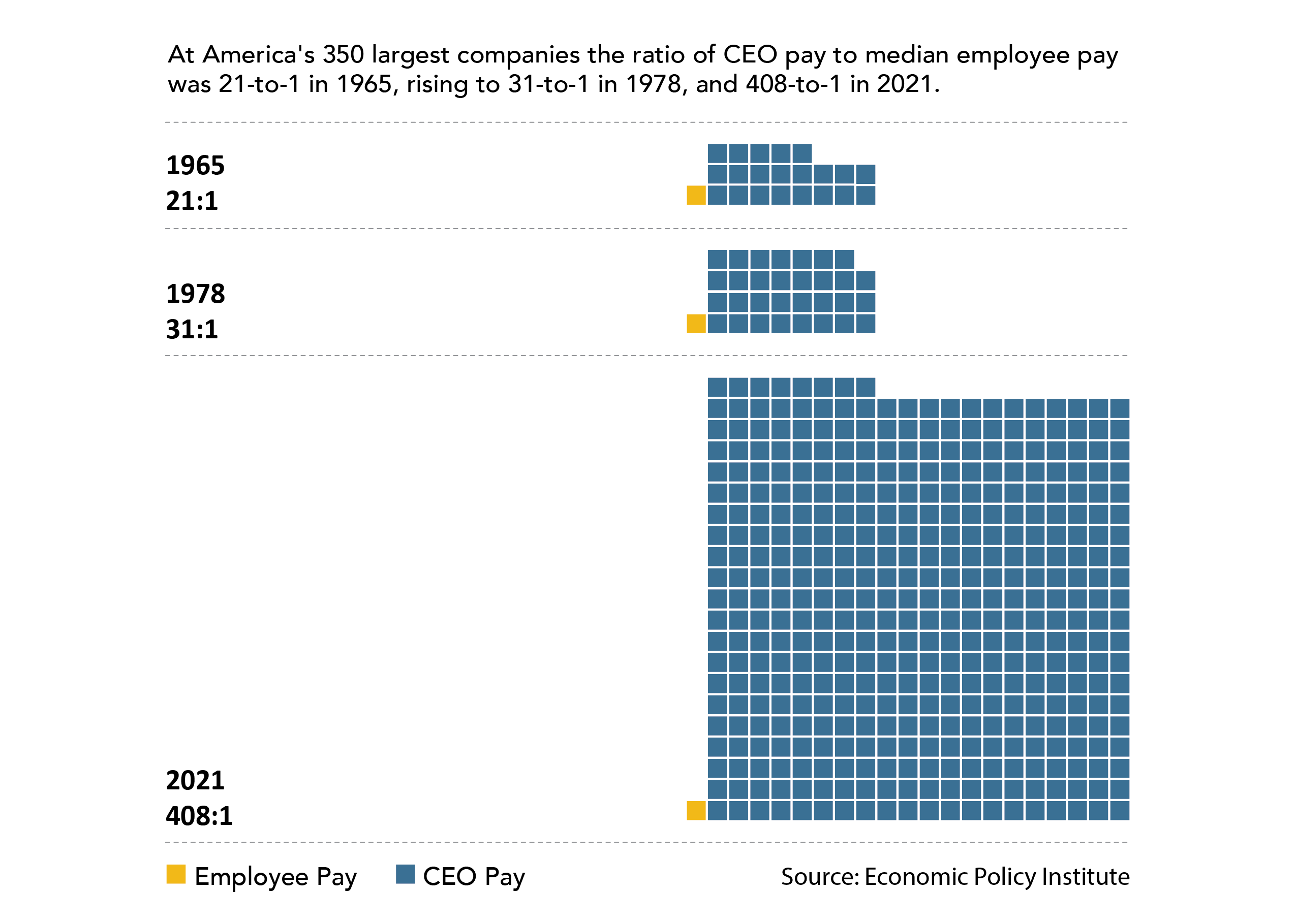
As of 2017, federal law requires publicly-traded companies to track and disclose the ratio between the compensation provided to their highest paid employee and their median employee. Analysis by the Economic Policy Institute shows that CEO pay has been rising substantially faster than median worker pay for decades. The ratio at America’s largest 350 companies was 21-to-1 in 1965, rising to 31-to-1 in 1978, and at its height to 408-to-1 in 2021. In 2017, the city of Portland, Oregon enacted a surtax of 10 percent on companies that have a ratio equal to or above 100-to-1, and a surtax of 25 percent on companies with a ratio exceeding 250-to-1.
The Commonwealth could introduce a similar surtax. It is not clear how much revenue such a tax would raise in Massachusetts. In the city of Portland, which has a far smaller economy than Massachusetts does, the surtax has raised about $5 million annually since 2017.[46] One limitation of using the federal Securities and Exchange Commission (SEC) data on CEO pay ratios to determine whether a business exceeds the ratios triggering surtax liability is that companies do not report these data unless they are traded publicly, which many businesses are not. Absent the SEC data, it is not possible to determine whether a company owes the surtax, at least not without additional reporting requirements.
25. Raising taxes on the profits of gambling operators
Legal gambling creates a variety of harms in Massachusetts that disproportionately hurt communities and households with lower incomes. The Commonwealth has accepted these harms in part because of the benefits generated from the revenue collected on profits from this gambling activity, as MassBudget has documented. The publicly operated Lottery dedicates all of its profits to state aid for cities and towns.[47] On the other hand, only a fraction of the profits generated by operating sports betting or resort casinos is collected as public revenue. The large corporations that operate sports betting in Massachusetts contribute only 20 percent of sports betting profits (after paying off winning bets) to the Commonwealth, and only 15 percent for sports bets placed at casinos. Meanwhile, the corporations operating the state’s two large resort casinos contribute 25 percent of profits from slot machines and other non-sports betting gambling activities in taxes. The third and far smaller Plainridge slots parlor is taxed at 49 percent.
Increasing the tax rates on gambling operations would change the division of gambling winnings between the Commonwealth and the shareholders of corporate gambling operators. In FY 2026, the tax on sports betting profits generated almost $170 million in revenue for the Commonwealth. If state-licensed operators of sports betting paid a tax rate of 50 percent, as in Delaware or Illinois or 51 percent, as in New York, New Hampshire, Rhode Island, or Oregon,[48] then tax revenue would increase by approximately a quarter billion dollars annually.[49] It is possible that with fewer profits available to sports betting corporations, they would less aggressively advertise and the rapid growth of the industry might slow. It is debatable whether this would be a downside or an upside of the higher tax rates.
Similarly, revenues could be increased by increasing the tax rates that casinos pay on their net revenue. If the tax on profits generated from casino slot machines and table games were increased to 50 percent, at both the one small and two large casinos in Massachusetts, it would generate an additional roughly quarter billion dollars annually. In addition, the Commonwealth is permitted by law to annually increase for inflation the annual license fee of $600 per slot machine, but the Gaming Commission has never done so.
Luxuries
26. Eliminate the sales tax exemption for aircraft
When consumers purchase a bicycle or an automobile, they pay the state’s 6.25 percent sales tax. But aircraft and aircraft parts currently receive a special exemption, subsidizing aircraft above other means of transportation or leisure. This special subsidy will cost the Commonwealth $33.7 million in Fiscal Year 2027, up 22 percent since FY 2023. Every dollar lost to this exemption is a dollar that could be instead invested in public programs or used for other forms of tax reductions.
Subsidizing private jets, helicopters, or other aircraft most benefits the people who buy them. Owning and operating an aircraft, especially for personal use, is an expensive and exclusive luxury. Aircraft owners tend to be very wealthy, especially those who own private jets. Meanwhile, almost a third of people with low incomes have never flown, even commercially. Special tax exemptions for private aircrafts worsens inequality in the Commonwealth.
State subsidies for aircraft also promotes the most environmentally destructive mode of transportation. Air travel burns extraordinarily large volumes of fuel, making it especially harmful for the environment and the climate. Traveling by private jets is at least 10 times more fuel-intensive than commercial air travel. By exempting aircrafts from sales tax, we are subsidizing this form of travel despite it worsening air quality and noise pollution and accelerating climate change. Eliminating the sales tax exemption would better align tax policy with state strategies to achieve net zero emissions by 2050 in the <Commonwealth’s Clean Energy and Climate Plan.
27. Eliminate the sales tax exemption on jet fuel
Fuel used in operating an aircraft is also not subject to the state’s 6.25 percent sales tax. The Healey Administration reports that the foregone revenue for exempting fuel used for aircraft or railroads together costs the Commonwealth $99.1 million annually.
In addition to exemption from sales tax, jet fuel also receives favorable treatment compared to other motor fuel excises. Aircraft fuel is also not subject to Massachusetts’ 24 cent motor fuel tax for automobiles that applies to gasoline or diesel. There is a separate, jet fuel excise that municipalities can choose to collect, which places a 5 percent tax on the sales price of jet fuel. Boston, Worcester, and eight other municipalities have chosen the option to levy this tax. As of the third quarter of 2026, the jet fuel tax in those municipalities amounted to the equivalent of 13.9 cents per gallon, about ten cents less per gallon than the tax on gasoline for automobiles.[50] Thus, depending on where jets are getting fueled, Massachusetts provides a subsidy on jet fuel amounting to 10 or 24 cents per gallon.
Automobiles and trucks do not pay a sales tax on gasoline on top of the gas tax in Massachusetts or most other states. But if the Commonwealth decides to continue to exempt jet fuel from the sales tax, what rationale is there to levy a smaller fuel excise or none at all for jets? Massachusetts already subsidizes aircraft travel by funding 33 non-commercial airports that are available to aircraft owners to take off and land their planes.
It is not clear why Massachusetts should give such favorable tax treatment to jet fuel. Jet travelers tend to have high incomes, especially owners of jets. Moreover, the consumption of jet fuel creates several kinds of costs on society. It is hazardous to human health. It contains naphthalene and benzene, which are linked to cancers such as leukemia. Studies by the Centers for Disease Control and Prevention (CDC) and the Veteran’s Administration also indicate that long-term exposure to jet fuel vapors (JP-8) can damage the nervous system, liver, and immune system. Jet fuel is particularly damaging to the climate.
28. Eliminate exemption of sales tax on transfers above $1,000 of precious metal bullion and coins
Acknowledgements
MassBudget would like to extend its gratitude to Eli Byerly-Duke, State Analyst at the Institute on Taxation and Economic Policy; Peter Enrich, emeritus professor of law at Northeastern University School of Law and former general counsel to the Massachusetts Executive Office for Administration and Finance; and Rachael Boyce, Director of Climate Justice and Resilience at Better Future Project. Their feedback, suggestions, and critical eye have made this report significantly better. Any errors are the sole responsibility of the authors.
Endnotes
1 Mattingly, Marybeth J., Sara Chaganti, Michael Evangelist, Marija Bingulac, and Gracie L. Griffin. 2026. “Family wealth in Massachusetts: Findings from the 2025 Massachusetts Economic Conditions and Household Opportunity Survey (Mass ECHOS).” Federal Reserve Bank of Boston.
2A 2015 Federal Reserve Bank of Boston survey found similarly stark disparities of wealth by race. See “The Color of Wealth in Boston,” FRBB (March 25, 2015).
3Analysis provided by the Institute on Taxation and Economic Policy, upon request by MassBudget.
4Even though households with more affluence on average consume more than households with lower incomes do, the spending by households with high incomes on taxed products — and hence the tax collected from these purchases — typically represents a much smaller portion of their income than is the case for a household with a low income. For that reason, consumption taxes and fees typically end up widening the gap between rich and poor. There may be other reasons to support consumption taxes or fees. Deposit fees on beverage containers, for example, encourage people to return them, though the resulting revenues are not progressive.
5Based on Department of Revenue preliminary totals for FY 2026 at https://www.mass.gov/news/fiscal-year-2026-revenue-collections-totaled-45542-billion
6Presently, capital gains, dividends, and interest are taxed at the same rate as wages and salary; although, a higher rate is applied to capital gains when an asset was held for less than a year.
7For the 2026 tax year, income exceeding $1,107,750 is subject to the 4 percent surtax
8In addition, tax filers with very low incomes qualify for “No Tax Status” and are not required to pay Massachusetts income tax. Tax filers with somewhat higher incomes qualify for a low-income credit. Single filers can only qualify for No Tax Status if their income is below $8,000 and those married filing jointly qualify with an income below $16,400 plus $1,000 per dependent. See Department of Revenue at https://www.mass.gov/service-details/learn-about-no-tax-status-and-limited-income-credit<
9Rulings by the Massachusetts Supreme Judicial Court (SJC) have indicated that while significant increases to such credits and exemptions very likely would pass constitutional muster, there is a limit to the size of increases that the SJC is likely to deem constitutional.
10Analysis provided by the Institute on Taxation and Economic Policy upon request by MassBudget.
11Massachusetts Department of Revenue analysis of An Act aligning the long-term capital gains tax rate with the short-term capital gains tax rate.
12Analysis provided by the Institute on Taxation and Economic Policy upon request by MassBudget.
13Combining the Fair Share surtax and the excise tax paid on income from pass-through corporations that have large volumes of gross sales, and adding these to the standard base tax rate, the total state tax rate applied to some income for some filers can be significantly higher than the base personal income tax rate of 5 percent.
14These revenue gain estimates include a rough modeling of modest declines in participation in the program as a result of a higher skim rate reducing the incentive to participate. MassBudget assumes a 10 percent decline in program participation at a 20 percent skim rate and a 20 percent decline in program participation at a 30 percent skim rate, with much of the drop in participation occurring among filers with incomes under $1 million per year (and thus with lower tax liability). Thus, a doubling of the skim rate does not simply yield a doubling of net revenue, nor does tripling the rate triple the revenue yield. At some high skim rate, enough participants would opt out of the program that the net revenue would even decline. But at skim rates below this high level, the Commonwealth can increase the skim rate significantly while continuing to provide most potential program participants with sufficient incentive to participate in the program. The question is how much should the PTE tax filer share their savings from avoiding federal taxes with the Commonwealth, in return for the Commonwealth facilitating those federal tax savings. Under the current, 10 percent skim rate, MassBudget estimates that PTE tax filers receive roughly three-quarters of the net benefits (including the federal tax reductions gained by PTE program participants), while the Commonwealth collects about a quarter of the net benefits. At a 30 percent skim rate, MassBudget estimates program participants would receive roughly a third of the net benefits, and the Commonwealth would receive about two-thirds of the net benefits.
15The Massachusetts Department of Revenue (DOR) does not publish data on the distribution of deductions by income group, but tax filers typically also file federal taxes and the IRS reports data on charitable deductions by income group and state. Federal tax rules differ somewhat from those of Massachusetts in terms of how taxable income is defined, but are broadly similar in the eligibility rules for charitable deductions. Thus, the IRS data, while not perfectly aligned, provide a good proxy for the unpublished Massachusetts DOR data. Due to various changes in the federal tax code made between 2022 and 2025, the IRS data on federal filings for tax year 2021 currently represents the best basis for approximating Massachusetts state deductions, at least until IRS 2026 personal income tax data by state becomes available. Analysis of the federal charitable deduction is likely to otherwise exaggerate the regressivity of the Massachusetts charitable deduction due to interaction with the federal rules governing the use of the standard deduction, which is not a feature of the Massachusetts personal income tax. In 2021, unlike 2022 through 2025, federal tax filers who utilized the standard deduction were allowed to claim a charitable deduction as well – much like they are in Massachusetts – though capped at $300 for an individual or $600 for a married couple. A version of this federal policy became permanent for 2026. Only a small fraction of tax filers itemize deductions on their federal tax return – less than ten percent and far fewer among tax filers with low and moderate incomes because their total deductions rarely exceed the standard deduction. Between 2022 and 2025, this meant that only a small minority of, mostly federal filers with high incomes itemized and could therefore have utilized the charitable deduction. (See IRS, Statement of Income (SOI) Tax Statistics, Tax Year 2021 Historical Data, Table 2, “Massachusetts.”) There are conflicting reasons to believe that the IRS data on Massachusetts charitable deductions could be more concentrated than for state deductions in Massachusetts, or whether it may understate the degree of concentration. The federal deduction in 2021 for tax filers who were taking the standard deduction was capped while the state deduction currently is not. This may not make much difference because few tax filers with low or moderate incomes would claim very large deductions anyway, and those few filers would be more likely to itemize at the federal level. But there will be some more tax filers with moderate incomes who would have their deductions capped at the federal level but not at the state level. On the other hand, the federal deduction is worth far more than the state deduction per contribution dollar because federal tax rates far exceed the state rate. Some Massachusetts tax filers who took the federal standard deduction in 2021 and claimed the capped federal charitable deduction might not bother just for the single digit deduction in Massachusetts.
16Hannah Martin, Laura Tomasko, Lewis Faulk, Mirae Kim, Jesse Lecy, and Elizabeth Boris, “Charitable Giving for Massachusetts Nonprofits in 2023,” Urban Institute (Dec. 2025).
17Hannah Martin, Laura Tomasko, Lewis Faulk, Mirae Kim, Jesse Lecy, and Elizabeth Boris, “Charitable Giving for Massachusetts Nonprofits in 2023,” Urban Institute (Dec. 2025), Figure 5, page 6. Note that the US rate is higher both for contributions above $250 and for contributions below this amount.
18The current rule encourages investors to artificially and unproductively “lock in” investments rather than selling assets when it makes most economic sense to do so. As the Congressional Research Office concluded, “Failure to tax capital gains at death encourages lock-in of assets, which in turn means less current turnover of funds available for investment.” Congressional Research Service, “Tax Expenditures,” https://www.gpo.gov/fdsys/pkg/CPRT-109SPRT31188/html/CPRT-109SPRT31188.htm (2006) Similarly, the current “stepped-up basis” rule encourages tax avoidance schemes where owners strip the value from assets without actually selling them as a way to avoid capital gains taxes.
19Center on Budget and Policy Priorities, “President’s Capital Gains Tax Proposals Would Make Tax Code More Efficient and Fair” (Jan. 2015) at https://www.cbpp.org/research/presidents-capital-gains-tax-proposals-would-make-tax-code-more-efficient-and-fair?fa=view&id=5260#_ftnref2. On the Simpson-Bowles proposal to “eliminate the ‘step-up basis’ loophole for capital gains at death,” see Center for a Responsible Federal Budget, “Capital Gains and Tax Reform” (Sept. 2012) at http://www.crfb.org/blogs/capital-gains-and-tax-reform
20Batchelder, Lily L. and Kamin, David, “Taxing the Rich: Issues and Options” (September 11, 2019). Available at SSRN: https://ssrn.com/abstract=3452274 or http://dx.doi.org/10.2139/ssrn.3452274
21Boston Globe, “Gonzalez revenue plan would tax state major colleges and universities,” (Sept. 2018) at https://www.bostonglobe.com/metro/2018/09/18/gonzalez-revenue-plan-would-tax-state-major-colleges-and-universities/Qq6cKSSFJ2IYSXD0aCo6ZO/story.html
22Castaldi, M. “Taxing Very High-Value Home Sales Is an Equitable and Effective Strategy to Raise Revenue and Fund Affordable Housing,” Center on Budget and Policy Priorities, July 19, 2024. See also, MassBudget “Local Revenue is a Key Tool to Advance Housing Affordability,” Feb. 2025.
23For instance, a locality might choose to exempt first-time homeowners or buyers who themselves will live in the residential unit.
24MassBudget, “Local Revenue is a Key Tool to Advance Housing Affordability” (Feb. 2025).
25While municipalities have some ability to raise local affordable housing funds through the Community Preservation Act, those surcharges also fall on more modest homes and therefore are not necessarily progressive in their economic impact. Moreover, most communities that opt into the Community Preservation Act already collect the maximum surcharge percentage and already dedicate a majority of those funds to affordable housing, despite the fee also being dedicated to open space preservation, recreation, and historic preservation. See MassBudget, “Local Revenue for Affordable Housing: Why the Community Preservation Act isn’t Enough,” June 2025.
26For a list, see “Municipalities” at Local Option for Housing Affordability.
27Arguments asserting that fees on expensive real estate discourage development tend to rely on a Toronto study of a tax introduced during the Great Recession. In addition to the economic downturn at the time, new development was also depressed by new Canadian mortgage regulations. See, Murtaza Haider & Amar Anwar & Cynthia Holmes, 2016. “Did the Land Transfer Tax Reduce Housing Sales in Toronto?,” IMFG Papers 28, University of Toronto, Institute on Municipal Finance and Governance.
28University of Massachusetts Amherst Donahue Institute, ”Analysis of proposed real estate transfer fees on Martha’s Vineyard and Nantucket for year-round housing” (April 2026).
29A total of 142,386 of all 203,589 businesses paying the corporate excise paid the minimum amount. See Massachusetts Department of Revenue, “A Report on 2022 Corporate Excise Returns.” This is the most recent year for which the Department has published data. See “Excise Due” row of Table 3, page 25 at https: https://www.mass.gov/doc/2022-corporate-excise-returns-report-0/download
30Along with Oregon and New York (among other states with tiered corporate minimums), Massachusetts’s neighbor, Vermont also uses a notably progressive system for its tiered corporate minimum tax.
31Banking and financial institutions, as well as insurance companies and some other types of businesses pay a different, though similar tax, often at somewhat higher tax rates.
32MassBudget report (2017), “How S-Corp and Other “Pass-Through” Income Is Taxed and the Effects of Proposed Tax Reforms”
33The rationale for collecting tax at the business entity level from larger S-corps is to roughly equalize the tax rates between C-corps and larger S-corps. Currently, C-corp profits are taxed at a rate of 8.0 percent in Massachusetts. Most personal income is taxed at a flat rate of 5 percent. By adding an entity-level tax of roughly 3 percent to larger S-corps, these S-corp profits are taxed at approximately the same overall rate as are C-corp profits: about 8 percent. This said, most pass-through income from S-corps flows to households with high incomes and thus a significant portion of this income now is subject to the 4 percent Fair Share surtax on incomes over $1 million. Combining the top marginal personal income tax rate of 9 percent (5 percent flat rate plus 4 percent surtax) with the 3 percent S-corp excise rate means that a good portion of S-corp income now is subject to a top marginal rate of 12 percent. This remains lower than the top marginal combined rate applied to the C-corp income of shareholders with high incomes: 8 percent (C-corp profits rate) plus 9 percent (top marginal rate on personal income) equals 17 percent.
34MassBudget analysis of Massachusetts Department of Revenue analysis provided to the Senate Revenue Working Group (2019-2020).
35See also Tax Policy Center analysis, “Tax Incentives for Pass-Through Income”, July 2020, Figure 4
36See, for example, Good Jobs First, “Smart Skills Versus Mindless Megadeals”, September 2016.
37MassBudget, “Building a Strong Economy: The Roles of Education, Transportation, and Tax Policy”, January 2016.
38For example, see Security and Exchange Commission 2022 filing for Blackstone, Inc, which provides a list of subsidiaries and affiliates 29 pages long: https://www.sec.gov/Archives/edgar/data/1393818/000119312524044485/d734131dex211.htm
39A recent Brookings Institution review of digital advertising tax proposals pegs global internet advertising revenues at some $600 billion a year currently, rising to over $1.1 trillion by 2030. A< study published by MIT professors estimates that about $450 billion a year of the $600 billion in current total global advertising sales revenue flows to the Big Three (Google, Meta/Facebook, and Amazon) alone. A portion of this $600 billion total roughly equal to Massachusetts’s share of total global economic activity (about seven-tenths of one percent of global GDP) is equal to about $4 billion a year, about $3 billion of which goes to the Big Three. Each one percentage point in the tax rate on this $3 billion of digital advertising revenue would generate $30 million annually in tax revenue.
40Despite an initial ruling striking down Maryland’s digital advertising tax, there is good reason to believe that this lower court ruling will be overturned on appeal. Moreover, whatever Maryland’s courts ultimately choose to do, other states remain free to pursue this option, just as other state courts are free to interpret the law in ways different from Maryland’s courts.
41Plattner, Robert and Mazerov, Michael and Shanske, Darien, A Model Tax on the Collection of Consumer Data by Commercial Data Collectors Based on New York’s Senate Bill 4489, 2025-2026 Legislative Session (April 10, 2026). Available at SSRN: https://ssrn.com/abstract=6556738 or http://dx.doi.org/10.2139/ssrn.6556738
42See Plattner, Robert, “The Virtues of a Simple Excise Tax on Personal Consumer Data” (2022); Rubenstein, Ziva, “Taxing Big Data” (2021); Zornetta & Ash, “Shearing the Sheep” (2024).
43The Commonwealth has a number of small, off-budget funds that are or could be used to support climate change mitigation and related efforts. Typically, most such funds are sporadically or minimally funded. These include: the Climate Change Adaptation Infrastructure Investment Fund, Global Warming Solutions Trust Fund, Massachusetts Alternative and Clean Energy Investment Trust Fund, Flood Control Compact Fund, Environmental Trust Fund, Department of Energy Resources Credit Trust Fund, Special Projects and Permitting Oversight Fund, Dam and Seawall Repair or Removal Fund, Water Pollution Abatement and Drinking Water Projects Administration Fund, Transportation Infrastructure Enhancement Trust Fund, Commonwealth Facility Trust for Energy Efficiency Fund, Electric Vehicle Adoption Incentive Trust Fund, Low-Income Solar Services Program Fund, Disaster Relief and Resiliency Fund, Environmental Justice Fund, MBTA Infrastructure Renovation Fund, District Local Technical Assistance Fund, and the Biodiversity Fund. See Massachusetts Fiscal Year 2025 Statutory Financial Basis Report, pgs 135-150.
44U.S. General Accountability Office (GAO), “FEMA Workforce: Staff Reductions and Mission Planning May Affect Mission Readiness,” GAO-26-108427 (August 4, 2026); and Center on Budget and Policy Priorities, “Trump Administration Actions Weakening Disaster Readiness and Response” (November 19, 2025).
45On how states can design climate superfunds to conform with prior legal precedents, see Rachel Rothschild, “State Climate Superfunds,” Columbia Law Review (May 2026). 46The City of Portland, Oregon sits within Multnomah County. The Federal Reserve Bank of St. Louis (FRED) pegs Multnomah County’s GDP in 2024 (the most current year for which data are available) at a little more than $90 billion. By contrast, FRED estimates the 2024 Massachusetts statewide economy at about $775 billion (and at about $850 billion in 2026). While the geographies are not the same – county vs. statewide estimates – the relative sizes of these two economies, and the likelihood that a similar share of the corporations operating in each area exceed the surtax thresholds, suggests that a similar surtax in Massachusetts on excessive CEO pay might generate something like five to ten times as much as the Portland, Oregon surtax does.
47In addition to using sales receipts to pay off winning bets, the Lottery also covers the costs of operating, regulating, and promoting its operations before transferring its net revenue to the Commonwealth. At the time of writing, it was not yet clear how the Lottery will divide profits on its new iLottery with private contractors operating the platform.
48Tax Foundation, “Online Sports Betting Taxes By State, 2026,” (September 2026)
49To simplify, this calculation assumes retail sports betting is subject to the same tax rate as online sports betting. Over 99 percent of sports betting subject to tax in Massachusetts is online.
50Users of generally small propeller planes that use aviation gasoline (Avgas) instead of jet fuel, pay a higher excise, amounting to 29.5 cents per gallon https://www.mass.gov/doc/massachusetts-fuels-excise-rate-table-2nd-quarter-2026/download